
SIP Investing vs Intraday Trading How the Two Work Differently
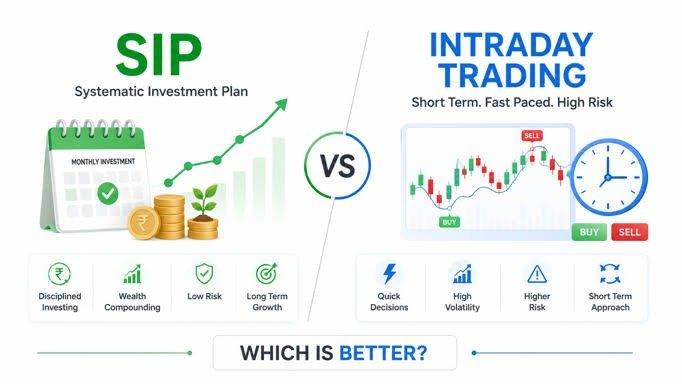
SIP investing and intraday trading are two different ways of participating in financial markets. While SIP investing involves putting a fixed amount into a mutual fund at regular intervals, intraday trading involves buying and selling securities within the same trading day. The difference is not limited to the holding period. The two approaches also vary in how investments are made, how closely markets need to be monitored, and how transactions are managed. This article explains these differences in simple terms and covers the main factors that investors may consider when understanding SIP investing and intraday trading.
What Is SIP Investing?
A Systematic Investment Plan (SIP) is a way to invest a fixed amount in a mutual fund at regular intervals. The frequency may be monthly, quarterly, or as offered by the selected scheme.
For example, an investor may choose to invest ₹2,000 every month in a mutual fund. Each instalment is used to purchase units of the selected scheme at its applicable Net Asset Value (NAV).
An SIP can be started and managed through an SIP app, depending on the services provided. The investor can generally select the amount, frequency, and date for the instalment.
What Is Intraday Trading?
Intraday trading involves buying and selling a security within the same trading session. A position opened during the day is generally closed before the market session ends.
For example, a trader may buy shares in the morning and sell them later on the same day. The transaction is based on the price movement of the security during that period.
Reliable trading apps can provide features such as live prices, charts, order placement, and position tracking for intraday transactions.
How Are SIP Investing and Intraday Trading Different?
The following are some basic differences between the two approaches.
| Basis | SIP Investing | Intraday Trading |
| Investment | Mutual fund units | Shares or other eligible securities |
| Frequency | Regular instalments | Trades during market hours |
| Holding Period | Usually longer than one trading session | Same trading session |
| Monitoring | Periodic monitoring may be sufficient | Regular market monitoring may be required |
| Decision Making | Based on scheme and investment objectives | Based on market movements and trading factors |
| Account | Mutual fund account or investment platform | Demat and trading account |
| Transaction Pattern | Fixed or scheduled investments | Buy and sell orders during the session |
How the Investment Process Differs
The following steps show how the two approaches generally work.
SIP Investment Process
- Select a mutual fund scheme after reviewing its objective and relevant information.
- Choose the SIP amount and investment frequency.
- Register the SIP through the selected platform.
- The specified amount is invested at the scheduled intervals.
- Mutual fund units are allocated based on the applicable NAV.
Intraday Trading Process
- Select a security after reviewing available market information.
- Analyse price movements and other relevant market factors.
- Place a buy or sell order through a trading platform.
- Monitor the open position during the trading session.
- Close the position before the trading session ends, as applicable.
What Factors Differentiate SIP Investing and Intraday Trading?
The following factors help explain how SIP investing and intraday trading require different approaches.
Investment Horizon
SIP investments are made at regular intervals and can continue over an extended period. Intraday trades are completed within one trading session.
Time Requirement
SIP investing generally involves setting up the investment schedule and reviewing the mutual fund periodically. Intraday trading may require more active attention to prices and open positions during market hours.
Market Exposure
SIP investments are linked to the performance of the selected mutual fund and its underlying securities. Intraday trading is directly affected by short-term price movements in the securities being traded.
Costs
SIP investments may involve fund-related expenses and other applicable charges. Intraday trading may involve brokerage, exchange charges, Securities Transaction Tax (STT), Goods and Services Tax (GST), and other applicable costs.
Who May Consider SIP Investing or Intraday Trading?
The two approaches have different processes and risk factors, so they should not be treated as interchangeable investment methods.
SIP Investing
SIP investing may be considered by individuals who prefer regular investments in mutual funds and do not want to place frequent market orders. It may also suit an investment approach where contributions are made at set intervals.
Intraday Trading
Intraday trading may be considered by individuals who are comfortable with buying and selling securities during market hours. It requires attention to market movements, order execution, and open positions.
Conclusion
SIP investing and intraday trading follow different methods of participating in financial markets. SIPs involve regular investments in mutual funds, while intraday trading involves buying and selling securities within the same trading session. They also differ in terms of time commitment, market monitoring, investment frequency, and transaction costs. Understanding these differences can help investors assess which approach matches their investment objectives and preferred level of market participation. Investing platforms such as 5Paisa provide digital access to mutual fund investments and trading services, allowing investors to manage different market activities through their platform.